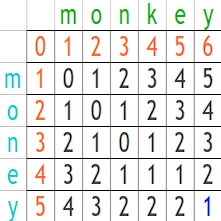
The distance between the source string and the target string is the minimum number of edit operations (deletions, insertions, or substitutions) required to transform the source into the target. The lower the distance, the more similar the two strings.Â
Among the common applications of the Edit Distance algorithm are: spell checking, plagiarism detection, and translation memory systems.
import nltk

w1 = 'mapping'
w2 = 'mappings'

nltk.edit_distance(w1, w2)
The output is 1 because the difference between "mapping" and "mappings" is only one character, "s".
import nltk

mistake = "ligting"

words = ['apple', 'bag', 'drawing', 'listing', 'linking', 'living', 'lighting', 'orange', 'walking', 'zoo']

for word in words:
    ed = nltk.edit_distance(mistake, word)
    print(word, ed)
You will get the output:
Sentence or paragraph comparison is useful in applications like plagiarism detection (to know if one article is a stolen version of another article), and translation memory systems (that save previously translated sentences and when there is a new untranslated sentence, the system retrieves a similar one that can be slightly edited by a human translator instead of translating the new sentence from scratch).
import nltk

sent1 = "It might help to re-install Python if possible."
sent2 = "It can help to install Python again if possible."
sent3 = "It can be so helpful to reinstall C++ if possible."
sent4 = "help It possible Python to re-install if might." # This has the same words as sent1 with a different order.
sent5 = "I love Python programming."

ed_sent_1_2 = nltk.edit_distance(sent1, sent2)
ed_sent_1_3 = nltk.edit_distance(sent1, sent3)
ed_sent_1_4 = nltk.edit_distance(sent1, sent4)
ed_sent_1_5 = nltk.edit_distance(sent1, sent5)


print(ed_sent_1_2, 'Edit Distance between sent1 and sent2')
print(ed_sent_1_3, 'Edit Distance between sent1 and sent3')
print(ed_sent_1_4, 'Edit Distance between sent1 and sent4')
print(ed_sent_1_5, 'Edit Distance between sent1 and sent5')
14 Edit Distance between sent1 and sent2
19 Edit Distance between sent1 and sent3
32 Edit Distance between sent1 and sent4
33 Edit Distance between sent1 and sent5
J(X,Y) = |Xâ©Y| / |XâªY|
 D(X,Y) = 1 â J(X,Y)
import nltk

w1 = set('mapping')
w2 = set('mappings')

nltk.jaccard_distance(w1, w2)
Unlike Edit Distance, you cannot just run Jaccard Distance on the strings directly; you must first convert them to the set type.
import nltk

mistake = "ligting"

words = ['apple', 'bag', 'drawing', 'listing', 'linking', 'living', 'lighting', 'orange', 'walking', 'zoo']

for word in words:
    jd = nltk.jaccard_distance(set(mistake), set(word))
    print(word, jd)
You will get the output:
import nltk

sent1 = set("It might help to re-install Python if possible.")
sent2 = set("It can help to install Python again if possible.")
sent3 = set("It can be so helpful to reinstall C++ if possible.")
sent4 = set("help It possible Python to re-install if might.") # This has the same words as sent1 with a different order.
sent5 = set("I love Python programming.")

jd_sent_1_2 = nltk.jaccard_distance(sent1, sent2)
jd_sent_1_3 = nltk.jaccard_distance(sent1, sent3)
jd_sent_1_4 = nltk.jaccard_distance(sent1, sent4)
jd_sent_1_5 = nltk.jaccard_distance(sent1, sent5)


print(jd_sent_1_2, 'Jaccard Distance between sent1 and sent2')
print(jd_sent_1_3, 'Jaccard Distance between sent1 and sent3')
print(jd_sent_1_4, 'Jaccard Distance between sent1 and sent4')
print(jd_sent_1_5, 'Jaccard Distance between sent1 and sent5')
You will get the result:
tokens = nltk.word_tokenize(sent)
n-grams can be used with Jaccard Distance. n-grams per se are useful in other applications such as machine translation when you want to find out which phrase in one language usually comes as the translation of another phrase in the target language.
Back to Jaccard Distance, let's see how to use n-grams on the string directly, i.e. on the character level, or after tokenization, i.e. on the token level.
import nltk

sent1 = "It might help to re-install Python if possible."
sent2 = "It can help to install Python again if possible."
sent3 = "It can be so helpful to reinstall C++ if possible."
sent4 = "help It possible Python to re-install if might." # This has the same words as sent1 with a different order.
sent5 = "I love Python programming."


ng1_chars = set(nltk.ngrams(sent1, n=3))
ng2_chars = set(nltk.ngrams(sent2, n=3))
ng3_chars = set(nltk.ngrams(sent3, n=3))
ng4_chars = set(nltk.ngrams(sent4, n=3))
ng5_chars = set(nltk.ngrams(sent5, n=3))

jd_sent_1_2 = nltk.jaccard_distance(ng1_chars, ng2_chars)
jd_sent_1_3 = nltk.jaccard_distance(ng1_chars, ng3_chars)
jd_sent_1_4 = nltk.jaccard_distance(ng1_chars, ng4_chars)
jd_sent_1_5 = nltk.jaccard_distance(ng1_chars, ng5_chars)

print(jd_sent_1_2, "Jaccard Distance between sent1 and sent2 with ngram 3")
print(jd_sent_1_3, "Jaccard Distance between sent1 and sent3 with ngram 3")
print(jd_sent_1_4, "Jaccard Distance between sent1 and sent4 with ngram 3")
print(jd_sent_1_5, "Jaccard Distance between sent1 and sent5 with ngram 3")
import nltk

sent1 = "It might help to re-install Python if possible."
sent2 = "It can help to install Python again if possible."
sent3 = "It can be so helpful to reinstall C++ if possible."
sent4 = "help It possible Python to re-install if might." # This has the same words as sent1 with a different order.
sent5 = "I love Python programming."

tokens1 = nltk.word_tokenize(sent1)
tokens2 = nltk.word_tokenize(sent2)
tokens3 = nltk.word_tokenize(sent3)
tokens4 = nltk.word_tokenize(sent4)
tokens5 = nltk.word_tokenize(sent5)

ng1_tokens = set(nltk.ngrams(tokens1, n=3))
ng2_tokens = set(nltk.ngrams(tokens2, n=3))
ng3_tokens = set(nltk.ngrams(tokens3, n=3))
ng4_tokens = set(nltk.ngrams(tokens4, n=3))
ng5_tokens = set(nltk.ngrams(tokens5, n=3))

jd_sent_1_2 = nltk.jaccard_distance(ng1_tokens, ng2_tokens)
jd_sent_1_3 = nltk.jaccard_distance(ng1_tokens, ng3_tokens)
jd_sent_1_4 = nltk.jaccard_distance(ng1_tokens, ng4_tokens)
jd_sent_1_5 = nltk.jaccard_distance(ng1_tokens, ng5_tokens)

print(jd_sent_1_2, "Jaccard Distance between tokens1 and tokens2 with ngram 3")
print(jd_sent_1_3, "Jaccard Distance between tokens1 and tokens3 with ngram 3")
print(jd_sent_1_4, "Jaccard Distance between tokens1 and tokens4 with ngram 3")
print(jd_sent_1_5, "Jaccard Distance between tokens1 and tokens5 with ngram 3")
You can run the two codes and compare results. Again, choosing which algorithm to use all depends on what you want to do.
If you have questions, please feel free to write them in a comment below.